Tech Support for LoRa Terminal
Expert troubleshooting, integration assistance, and dedicated support options.
Downloads & Guides
Access the latest firmware, manuals, and software tools.
Integration Support
Need assistance configuring protocols or connecting to SCADA?
Book Remote SessionTechnical Specifications
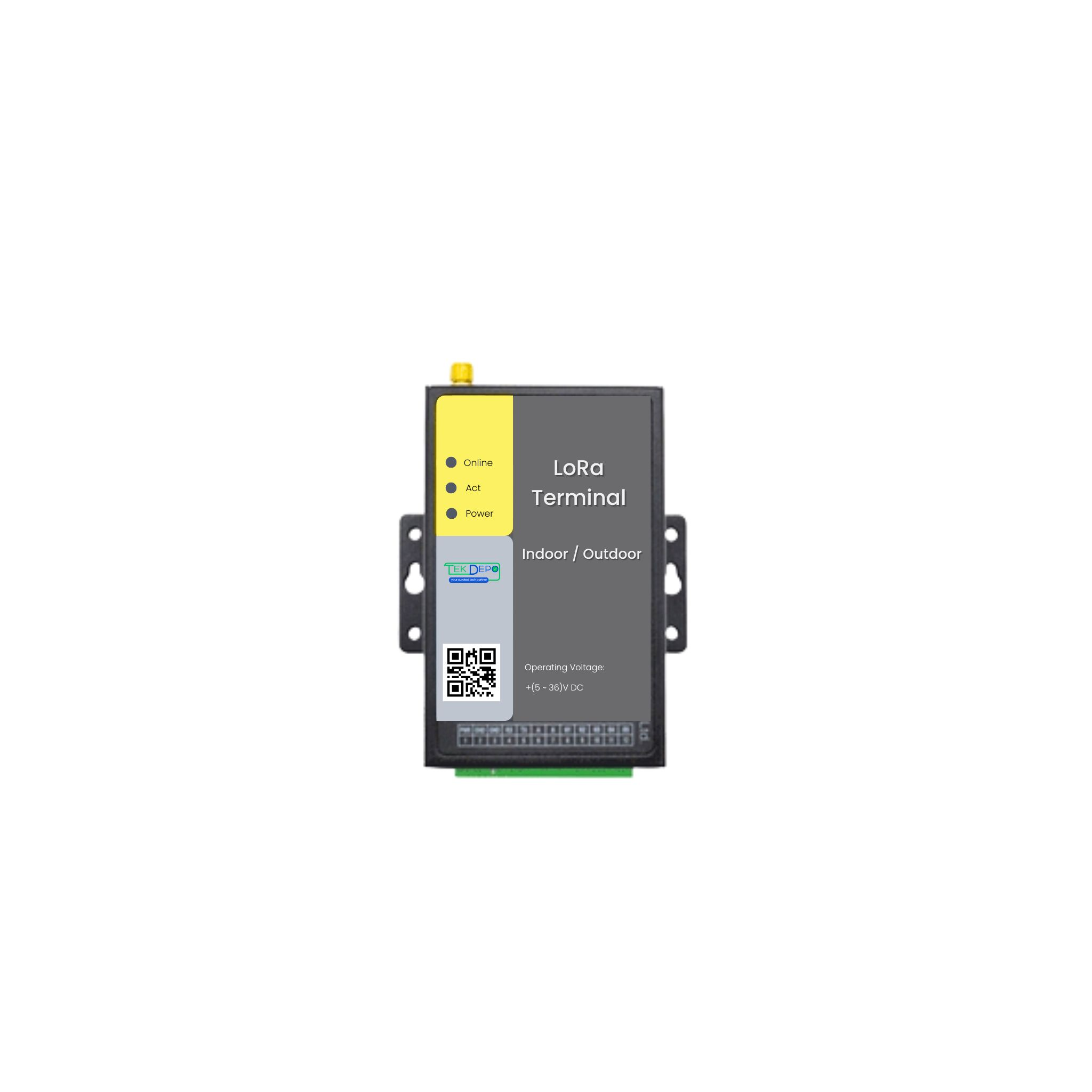
| LoRa Communication | Frequency Bands: 433 / 470 / 780 / 868 / 915 MHz | Modulation Technology: LoRa Spread Spectrum | Receiver Sensitivity: -140 dBm | Bandwidth: 6 levels adjustable (0.3 / 0.6 / 1.0 / 1.8 / 3.1 / 5.5 Kbps) | Transmission Power: Up to 30 dBm (model dependent) | Outdoor Communication Distance: Up to 11.5 km (line-of-sight) | Indoor Communication Distance: Up to 2 km (urban environment) |
|---|---|---|---|---|---|---|---|
| Interfaces & I/O | Serial Ports: 1 × RS232, 1 × RS485 or RS422 | I/O Channels: 5 channels (3 analog inputs, 2 digital I/O with pulse counting) | Baud Rate: 300 to 115200 bps | ESD Protection: 15KV on serial interfaces | Antenna Interface: SMA female, 50Ω, lightning protection optional | ||
| Hardware & System | Processor: Industrial-grade 32-bit CPU | Wireless Module: High-power industrial LoRa module | Watchdog: Hardware and software watchdog supported | Network Capability: Self-organizing LoRa network with relay routing support | Node Capacity: Up to 65,000 nodes (typical deployment ~300 nodes) | ||
| Power & Consumption | Input Voltage: DC 5–36V | Standard Power Supply: DC 12V / 0.5A | Sleep Current: As low as 3.1 mA @12V | Transmit Current: Up to 125 mA @12V (model dependent) | Protection: Reverse-voltage and over-voltage protection | ||
| Mechanical & Environmental | Enclosure: Metal housing | Protection Rating: IP30 | Dimensions: 91 × 58.5 × 22 mm | Weight: 205 g | Operating Temperature: -40°C to +85°C | Storage Temperature: -40°C to +125°C | Operating Humidity: Up to 95% (non-condensing) |
Frequently Asked Questions
Find answers to common questions about our products
What is the primary use of the LoRa Terminal?
The LoRa Terminal is used for long-range, low-power wireless data transmission in industrial IoT and M2M applications such as smart factories, utilities, transportation systems, telemetry, and environmental monitoring.
How far can the LoRa Terminal transmit data?
The device supports communication distances of up to 11.5 km in outdoor line-of-sight conditions and up to 2 km in dense urban or indoor environments.
Which serial interfaces are supported?
It supports RS232 and RS485 or RS422 interfaces, enabling direct connection to PLCs, sensors, meters, and other industrial equipment.
Can the LoRa Terminal operate in harsh industrial environments?
Yes, it features a metal enclosure, wide operating temperature range, ESD protection, and watchdog mechanisms for stable operation in harsh industrial conditions.
How is the LoRa Terminal powered?
The device supports a wide DC input range of 5–36V, with a standard operating voltage of 12V, making it suitable for various industrial power systems.
Does the device support network expansion?
Yes, it supports self-organizing LoRa networks with relay routing, allowing scalable deployments with thousands of nodes.
What installation options are available?
The LoRa Terminal is typically installed using terminal block wiring and external antennas, and it can be mounted inside control panels or industrial enclosures.
Is lightning protection supported?
Lightning protection is available as an optional feature on the antenna interface for outdoor and high-risk installations.
Still have questions?
Contact Our TeamNeed specialized help?
If the guides above didn't resolve your issue, our engineering team is here to assist with complex integrations.