Tech Support for CAN to USB Analyzer
Find setup guides, datasheets, and expert support options below.
Downloads & Guides
Access the latest firmware, manuals, and software tools.
Integration Support
Need assistance configuring protocols or connecting to SCADA?
Book Remote SessionTechnical Specifications
| Technical Specifications | Power Supply: 10 to 30V DC | PC Communication: Compatible with USB 2.0 and above | CAN Communication: CAN bus connection via Terminal Connector, 8-pin | Baud Rate - CAN Bus: Supports up to 1 MBPS | Operating Condition: Operating temperature range from -40 to 85 °C | Communication Mode: Bidirectional | CAN Bus Version Support: Compliant with CAN Specifications 2.0A and 2.0B | Response Time: Time stamp resolution of approximately 1 ms |
|---|---|---|---|---|---|---|---|---|
| Key Features | Easy and quick connection to CAN networks and CAN devices. | Small size and compact plastic casing. | Free CAN application software for Windows® with an attractive and user-friendly GUI. | API SDK support for custom GUI and application development. | ||||
| Typical Applications | CAN Network Analysis & Troubleshooting. | Battery Management System. | Vehicle Network Analysis & Troubleshooting. | CAN 2.0A and CAN 2.0B machines monitoring. |
Frequently Asked Questions
Find answers to the most common questions about this product.
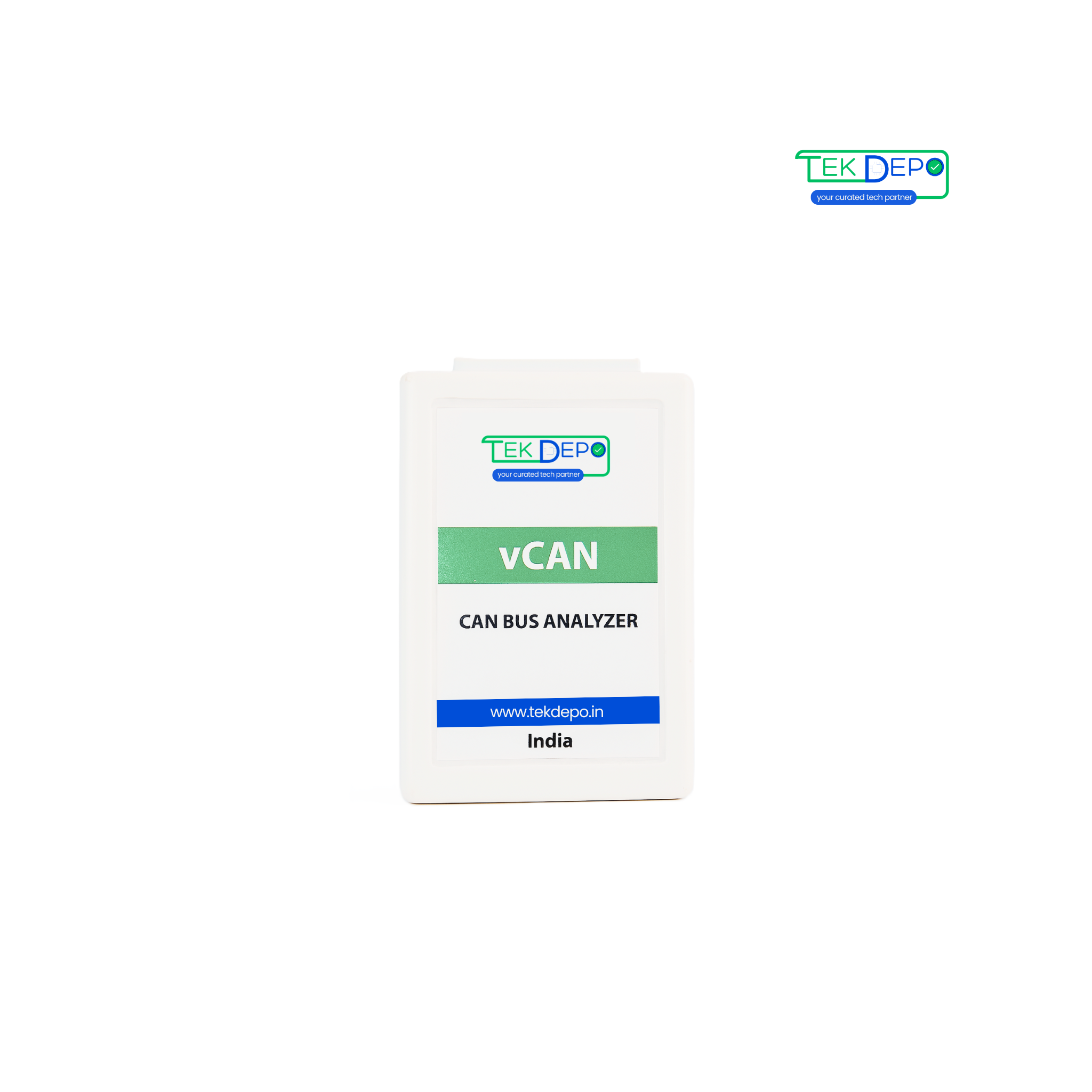
The CAN to USB Analyzer is a compact diagnostic and testing tool that connects a CAN network to a PC via USB, enabling data monitoring, debugging, and communication analysis.
It supports both CAN 2.0A and CAN 2.0B standards, providing compatibility with most industrial and automotive communication networks.
This device is perfect for automotive engineers, embedded developers, system integrators, and graduates learning CAN Bus communication and programming.
Features include bidirectional CAN communication, real-time monitoring, GUI-based interface (SW Suite), error frame detection, and message filtering capabilities.The device comes with GUI software that allows users to visualize, log, and analyze CAN bus messages efficiently.
It is widely used in automotive development, CAN bus diagnostics, network simulation, and academic research involving embedded systems.
Still have questions? Contact our support team