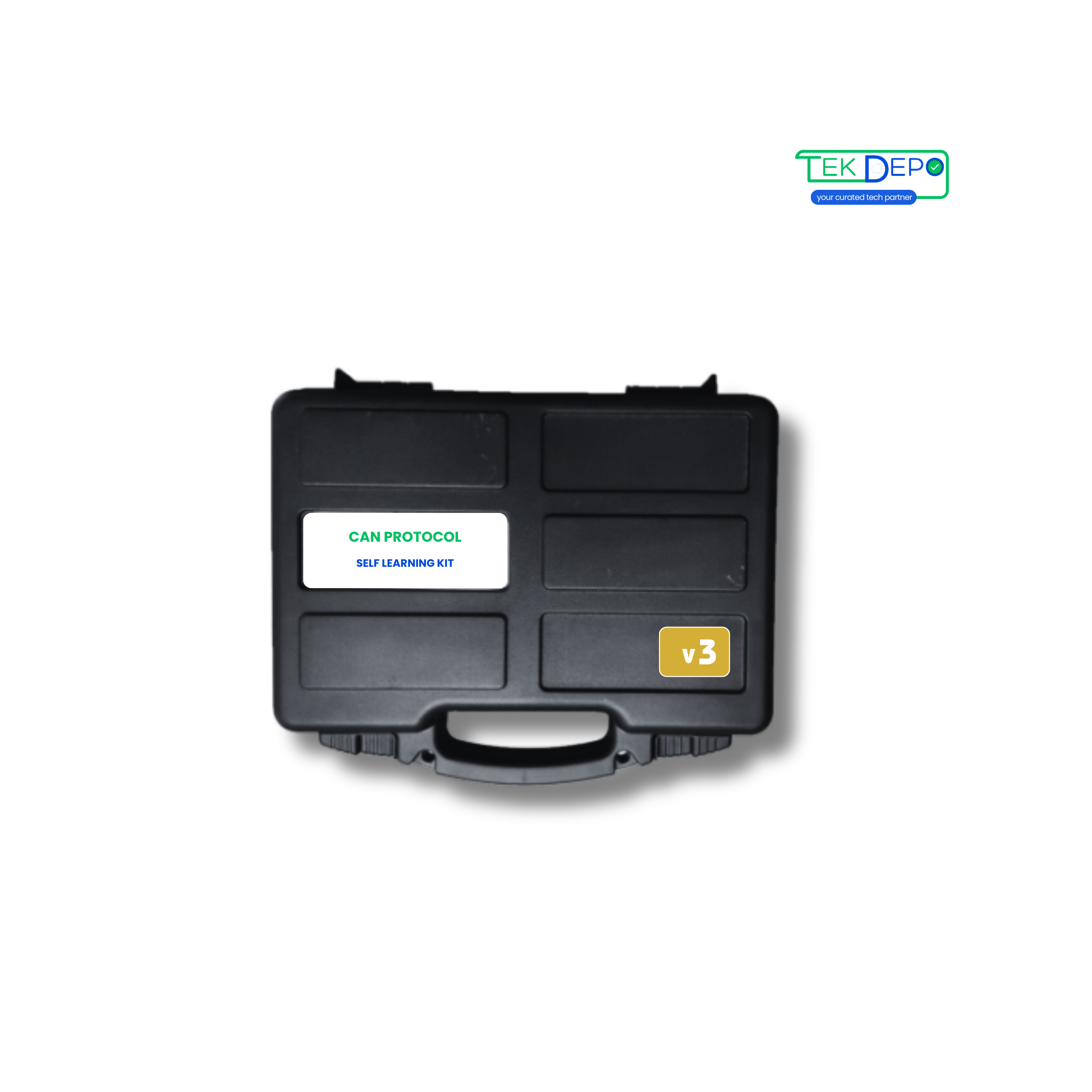
Tech Support for CAN Protocol Self Learning Kit v3
Find setup guides, datasheets, and expert support options below.
Downloads & Guides
Access the latest firmware, manuals, and software tools.
Integration Support
Need assistance configuring protocols or connecting to SCADA?
Book Remote SessionTechnical Specifications
| Kit Contents | CAN Nodes (1 Configurable & 1 Programmable) | CAN Bus to USB Converter | USB Cables | USB 3.0 Hub | Connecting wires & jumpers (removable) | Termination adapter (optional) | ||||
|---|---|---|---|---|---|---|---|---|---|---|
| Technical Specifications | Power Supply: Powered through USB | PC Communication: Compatible with USB 2.0 | Inputs: Digital – 8; Analog – 4 | Outputs: Digital – 8; Analog – 2 | CAN Communication: On-board CAN bus connection, 3-pin each | Baud Rate - CAN Bus: Supports up to 1 MBPS | Communication Mode: Bidirectional | CAN Bus Version Support: Compliant with CAN Specifications 2.0A and 2.0B | Indicators: LEDs for configuration, digital & analog output | Operating Condition: Operating temperature range from -20 to 85 °C |
| Key Features | GUI – Unimod (configuration software) and CAN Bus application | Inbuilt debugger for custom C code development and debugging | GUI-based CAN configurations including baud rate, filters, message IDs, and analog & digital I/Os | |||||||
| Applications | CAN bus fault testing | CAN 2.0A and CAN 2.0B monitoring | CAN bus learning and hands-on practice | CAN bus network analysis and troubleshooting |
Frequently Asked Questions
Find answers to the most common questions about this product.
Version 3 is an advanced learning kit that combines one configurable CAN node with one programmable CAN node for deeper CAN application development.
A programmable CAN node allows users to write and debug custom C code to control CAN communication behavior beyond standard configuration.
This version is best suited for embedded developers, advanced students, and professionals who want hands-on CAN firmware development experience.
Yes, the kit includes an inbuilt debugger and API/SDK support for custom CAN application development.
Version 3 fully supports CAN 2.0A and CAN 2.0B protocols with baud rates up to 1 Mbps.
Applications include CAN network simulation, embedded CAN firmware development, diagnostics, and troubleshooting.
Still have questions? Contact our support team